
Industrial and Forklift Wheels for Heavy-Duty Material Handling
Industrial and forklift wheels are essential for efficient movement of goods in demanding environments. These solutions, including industrial caster wheels, heavy-duty equipment wheels, and warehouse trolley wheels, deliver reliable performance for material handling and machinery transport.
- ✔ Engineered for high load capacities and durability
- ✔ Compatible with a wide range of industrial and warehouse equipment
- ✔ Designed for smooth, safe, and stable operation
- ✔ Ideal for frequent use in tough material handling applications
Find the perfect option and order now!
Frequently Asked Questions
To find a suitable complete wheel, we need five pieces of information:
- Tyre size — shown on the sidewall of the old tyre, for example 195/50 R13.
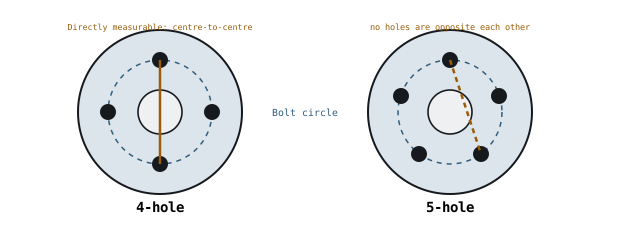
- Number of holes and bolt circle diameter — how many wheel bolts and what is the bolt circle diameter. For a four-hole pattern, measure from the centre of one hole to the centre of the hole directly opposite. With a five-hole pattern, this isn’t possible directly because no hole is directly opposite — in this case, it helps to check the vehicle documents or a photo of the back of the rim.
- Offset (ET) — see below.
- Hub bore (centre hole) — the diameter of the opening in the centre of the rim.
- Load capacity — the load index must match the axle load, and must be at least the value stated in the vehicle documents.
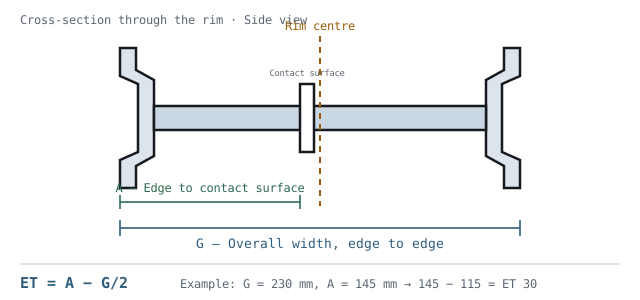
What the offset (ET) does: It indicates how far the contact surface of the rim is from the centre of the rim, and thus determines how far the wheel protrudes outwards or inwards. An ET that is too small will cause the wheel to rub against the outer edge of the mudguard; one that is too large will cause it to rub against the brake or the frame on the inside.
Reading the offset: It is usually stamped on the inside of the rim, for example ‘ET30’. If there is no stamp, measure it yourself.
Measuring the ET yourself — here’s how:
- Remove the wheel and lay it flat, ideally with the outer side facing downwards.
- Measure the total width G of the rim: from the outer edge of one rim flange to the outer edge of the other. Half of this distance is the centre of the rim.
- Measure dimension A: place a straight ruler across the top rim flange and determine the distance from this edge to the hub contact surface — that is, to the surface that rests against the vehicle.
- Calculation: ET = A − G/2
Example: Total width 230 mm, measurement A 145 mm. Centre of the rim = 115 mm. ET = 145 − 115 = 30. A positive result means that the contact surface lies outside the centre of the rim — this is the normal case. A value of zero means it is exactly centred, whilst negative values indicate it lies further inwards.
The quickest way is still to take a photo of the back of the old rim — this shows the bolt pattern and usually the embossed dimensions as well.
To choose from: complete wheels.
Note: Our complete trailer wheels are not balanced — this is not usually necessary for car trailers.

There are no product filters available for current page
{{ filter.fu || tmpValue.vn }}






Product Overview
Industrial and forklift wheels are designed to meet the rigorous demands of material handling in industrial, agricultural, and warehouse settings. This category includes high-quality industrial caster wheels, heavy-duty equipment wheels, and warehouse trolley wheels, ensuring smooth transportation of machinery and goods. Each wheel is engineered for reliability, making them suitable for both frequent and intensive use. The robust construction and quality materials guarantee long-lasting performance, even under challenging conditions.
Key Features & Benefits
These material handling wheels are built to withstand heavy loads and constant movement. Their sturdy design provides excellent stability and reduces downtime due to maintenance or replacement. The wheels are compatible with a variety of machinery and trolleys, offering flexibility for different applications. Enhanced traction and smooth rolling capabilities help maintain safety and efficiency in busy warehouse environments. Their versatility makes them an excellent choice for professionals seeking dependable solutions for equipment mobility.
Selection Guide
Choosing the right industrial and forklift wheels involves considering the intended application, load requirements, and floor conditions. For heavy-duty equipment, opt for wheels with reinforced rims and high-quality bearings. For warehouse trolley wheels, prioritize models that offer smooth rolling and minimal resistance. Always ensure compatibility with your existing machinery to maximize operational efficiency and safety. Consulting with a specialist can help you identify the most suitable option for your specific needs.
Applications
These wheels are widely used in industrial facilities, warehouses, agricultural operations, and horticultural settings. They are ideal for transporting heavy machinery, materials, and equipment across various surfaces. Whether you need to move goods within a warehouse or support machinery in a production environment, industrial and forklift wheels provide the durability and reliability required for seamless material handling operations.
Find the right option now and order online.
Nachrichten Kategorie

Excellent


