

Complete wheel 195/70 R14C GT Radial Kargomax ST-6000 M+S steel rim 5 x 140mm
184,90 €
Complete wheel 195/70 R14C GT Radial Kargomax ST-6000 M+S steel rim 5 x 140mm
184,90 €
Shipping price from: 6,90 €
This item cannot be collected in person
Product Product in stock

Complete wheel 195/70 R14C GT Radial Kargomax ST-6000 M+S steel rim 5 x 140mm
Product.Nr.: 990016808
Manufacturer: GT Radial
This complete wheel 195/70 R14C with GT Radial Kargomax ST-6000 M+S tread is a robust solution for agricultural and horticultural applications, especially for trailers, machinery and transport equipment. The combination of a sturdy steel wheel and a durable C tyre (Commercial) offers high load capacity, reliable performance and good running characteristics at low to medium speeds. Thanks to the M+S marking, the tread is also suitable for use in mud and snow.
Technical data
- Product type: Complete wheel
- Industry: Agriculture and horticulture
- Brand: GT radial
- Series: serie 48
- Tyre size: 195/70 R14C
- Diameter: 630 mm
- Width: 201 mm
- Tread: Kargomax ST-6000 M+S
- Rim size: 14 inch
- Tyre type: TL (Tubeless)
- Rim: 5Jx14H2
- Offset: ET0
- Wheel design: 1-piece
- Bolt pattern: 94/140/5
- Load index (LI): 104/102
- Speed index (SI): N
- Wheel material: Steel
- Rim colour: grey
- Max. load capacity: 650 kg
- Tyre pressure: 4.5 bar
- Max. speed: 40 km/h
Benefits and application
This complete wheel is ideal for agricultural trailers, yard and garden equipment as well as light transport vehicles where reliability and load capacity are paramount. The robust grey steel rim is resistant to mechanical stress and suitable for daily use under demanding conditions.
The load index 104/102 and the maximum load capacity of 650 kg allow use with higher payloads, while the speed index N and the maximum speed of 40 km/h are matched to typical working and transport speeds in the agricultural and horticultural sector. The TL (tubeless) construction reduces maintenance effort and potential sources of failure caused by inner tubes.
The M+S Kargomax ST-6000 tread provides good grip on unpaved tracks, meadows, fields and in wetter conditions. With the ET0 offset and the 94/140/5 bolt pattern, the wheel is designed for suitable hub fittings in industrial and agricultural applications.
Explanation of technical terms
- TL (Tubeless): Tubeless tyre that seals directly on the rim. Advantage: fewer components, lower risk of punctures due to tube failures.
- LI (Load Index): Code number for the maximum permissible load capacity of a tyre. LI 104/102 indicates the load capacity in single and twin fitment.
- SI (Speed Index): Indicates the maximum permissible speed for which the tyre is designed. Index N corresponds to up to 140 km/h; in this case, however, the wheel is structurally limited to 40 km/h.
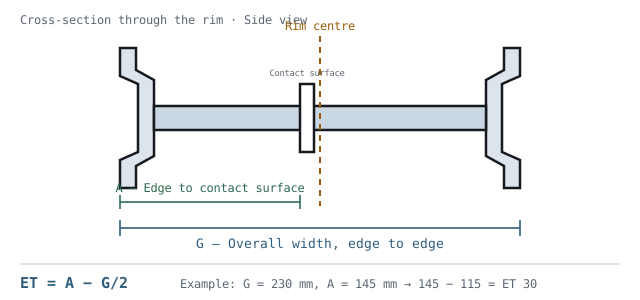
- ET (Offset): Distance between the centreline of the rim and the contact surface of the rim on the hub. ET0 means that the contact surface is located in the centre of the rim.
- M+S: Marking for mud and snow. Indicates a tread optimised for poorer ground and weather conditions.
- C in the size (R14C): Stands for “Commercial” and designates reinforced tyres for commercial vehicles, trailers and work machinery.
Frequently asked questions about this product
To find a suitable complete wheel, we need five pieces of information:
- Tyre size — shown on the sidewall of the old tyre, for example 195/50 R13.
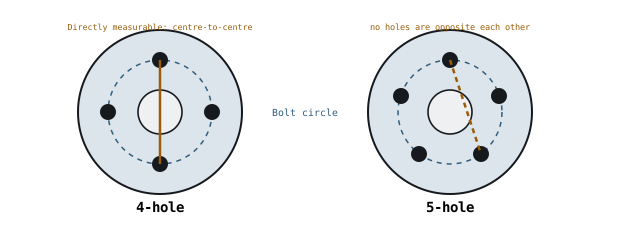
- Number of holes and bolt circle diameter — how many wheel bolts and what is the bolt circle diameter. For a four-hole pattern, measure from the centre of one hole to the centre of the hole directly opposite. With a five-hole pattern, this isn’t possible directly because no hole is directly opposite — in this case, it helps to check the vehicle documents or a photo of the back of the rim.
- Offset (ET) — see below.
- Hub bore (centre hole) — the diameter of the opening in the centre of the rim.
- Load capacity — the load index must match the axle load, and must be at least the value stated in the vehicle documents.
What the offset (ET) does: It indicates how far the contact surface of the rim is from the centre of the rim, and thus determines how far the wheel protrudes outwards or inwards. An ET that is too small will cause the wheel to rub against the outer edge of the mudguard; one that is too large will cause it to rub against the brake or the frame on the inside.
Reading the offset: It is usually stamped on the inside of the rim, for example ‘ET30’. If there is no stamp, measure it yourself.
Measuring the ET yourself — here’s how:
- Remove the wheel and lay it flat, ideally with the outer side facing downwards.
- Measure the total width G of the rim: from the outer edge of one rim flange to the outer edge of the other. Half of this distance is the centre of the rim.
- Measure dimension A: place a straight ruler across the top rim flange and determine the distance from this edge to the hub contact surface — that is, to the surface that rests against the vehicle.
- Calculation: ET = A − G/2
Example: Total width 230 mm, measurement A 145 mm. Centre of the rim = 115 mm. ET = 145 − 115 = 30. A positive result means that the contact surface lies outside the centre of the rim — this is the normal case. A value of zero means it is exactly centred, whilst negative values indicate it lies further inwards.
The quickest way is still to take a photo of the back of the old rim — this shows the bolt pattern and usually the embossed dimensions as well.
To choose from: complete wheels.
Note: Our complete trailer wheels are not balanced — this is not usually necessary for car trailers.
Last viewed


Reviews marked “Verified Purchase” are from customers who have bought the product from our shop. Reviews without this label may also be from consumers who have not purchased the products in question. These have not been verified for authenticity.
E-Mail adress: info@eu.giti.com
Streetaddress: Hollerithallee 18a
ZIP Code: 30419
City: Hannover
Country: DE
Phone: +49 (0)51151535610

