
What information do I need to find a suitable complete bike — and how do I measure the offset?
To find a suitable complete wheel, we need five pieces of information:
- Tyre size — shown on the sidewall of the old tyre, for example 195/50 R13.
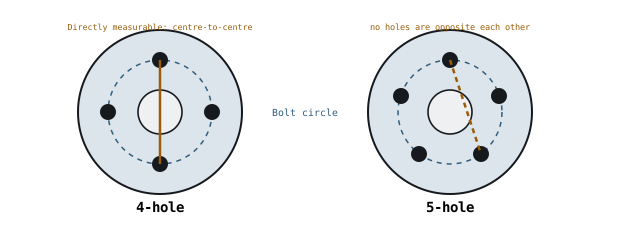
- Number of holes and bolt circle diameter — how many wheel bolts and what is the bolt circle diameter. For a four-hole pattern, measure from the centre of one hole to the centre of the hole directly opposite. With a five-hole pattern, this isn’t possible directly because no hole is directly opposite — in this case, it helps to check the vehicle documents or a photo of the back of the rim.
- Offset (ET) — see below.
- Hub bore (centre hole) — the diameter of the opening in the centre of the rim.
- Load capacity — the load index must match the axle load, and must be at least the value stated in the vehicle documents.
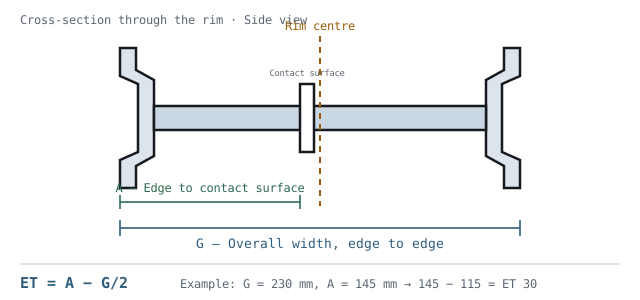
What the offset (ET) does: It indicates how far the contact surface of the rim is from the centre of the rim, and thus determines how far the wheel protrudes outwards or inwards. An ET that is too small will cause the wheel to rub against the outer edge of the mudguard; one that is too large will cause it to rub against the brake or the frame on the inside.
Reading the offset: It is usually stamped on the inside of the rim, for example ‘ET30’. If there is no stamp, measure it yourself.
Measuring the ET yourself — here’s how:
- Remove the wheel and lay it flat, ideally with the outer side facing downwards.
- Measure the total width G of the rim: from the outer edge of one rim flange to the outer edge of the other. Half of this distance is the centre of the rim.
- Measure dimension A: place a straight ruler across the top rim flange and determine the distance from this edge to the hub contact surface — that is, to the surface that rests against the vehicle.
- Calculation: ET = A − G/2
Example: Total width 230 mm, measurement A 145 mm. Centre of the rim = 115 mm. ET = 145 − 115 = 30. A positive result means that the contact surface lies outside the centre of the rim — this is the normal case. A value of zero means it is exactly centred, whilst negative values indicate it lies further inwards.
The quickest way is still to take a photo of the back of the old rim — this shows the bolt pattern and usually the embossed dimensions as well.
To choose from: complete wheels.
Note: Our complete trailer wheels are not balanced — this is not usually necessary for car trailers.

