
What do the markings on a trailer tyre mean, and how old can it be?
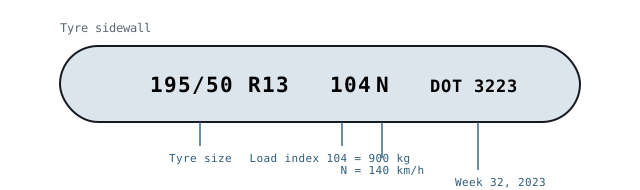
Age: Trailer tyres age more as a result of being left stationary than from the number of kilometres travelled. It is advisable to replace them after around six years, even if the tread is still in good condition; for trailers approved for 100 km/h, this is mandatory. The date of manufacture is shown as a DOT number on the sidewall: 3223 means the 32nd calendar week of 2023.
Load capacity (Load Index, LI): The number before the letter indicates the load capacity per tyre. The fitted tyre must meet at least the value stated in the vehicle documents — a higher value is permitted, but a lower one is not.
| LI | kg | LI | kg | LI | kg | LI | kg |
|---|---|---|---|---|---|---|---|
| 60 | 250 | 80 | 450 | 95 | 690 | 108 | 1,000 |
| 65 | 290 | 82 | 475 | 98 | 750 | 110 | 1060 |
| 70 | 335 | 85 | 515 | 100 | 800 | 112 | 1120 |
| 75 | 387 | 88 | 560 | 102 | 850 | 115 | 1215 |
| 78 | 425 | 90 | 600 | 104 | 900 | 120 | 1400 |
Speed index: The letter following the load index indicates the maximum permitted speed. An ‘L’ is required for a 100 km/h rating.
| Index | km/h | Index | km/h | Index | km/h |
|---|---|---|---|---|---|
| J | 100 | M | 130 | Q | 160 |
| K | 110 | N | 140 | R | 170 |
| L | 120 | P | 150 | H | 180 |
Winter tyres: There is no requirement for winter tyres on trailers, as the wheels are not driven. An M+S or Alpine symbol is not required.
Tyre pressure: Trailer tyres require significantly higher pressure than car tyres. The correct pressure is specified in the vehicle documents or on the sticker on the trailer. Insufficient pressure is the most common cause of tyre damage.
Tread depth: the legal minimum is 1.6 mm. You can also recognise old tyres by fine cracks in the sidewall and tread base.
Replacement: Tyres and complete wheels.

