

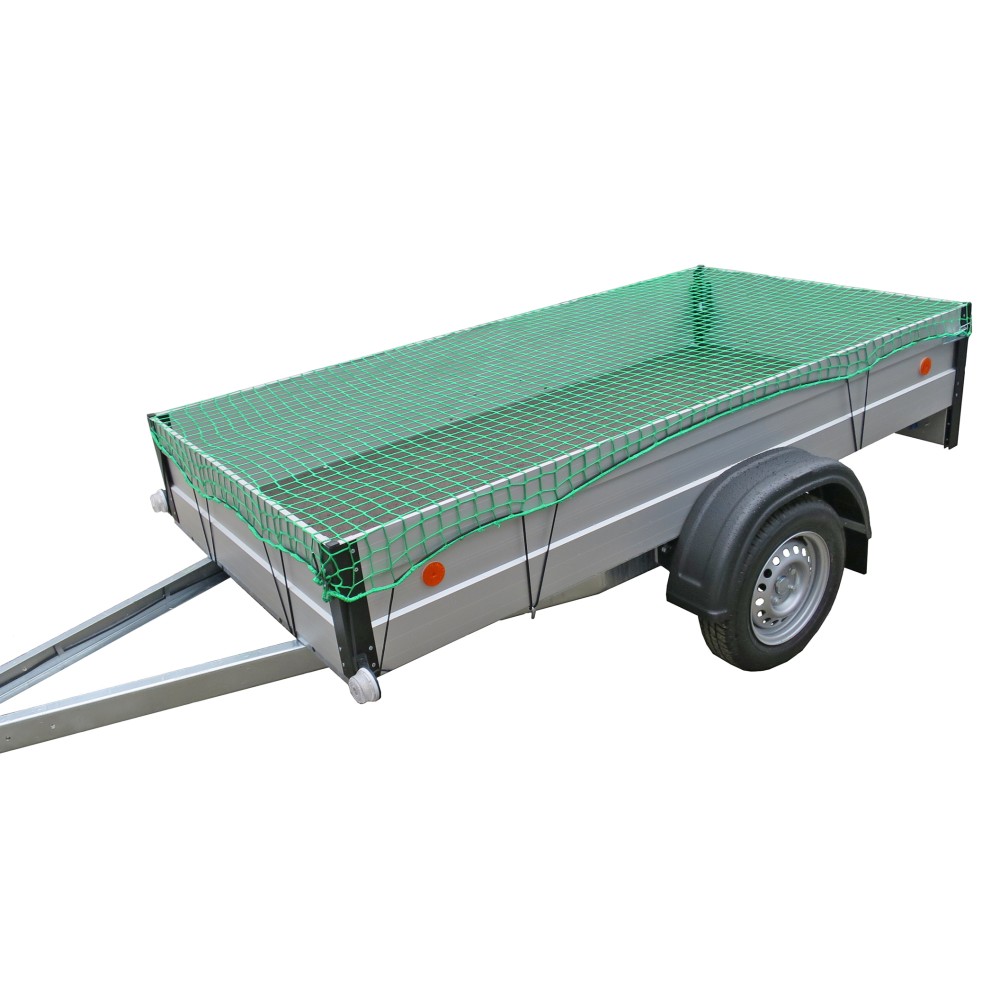
Net / trailer net for load securing 3.3 x 2.1 m with rubber cord
30,90 €
Net / trailer net for load securing 3.3 x 2.1 m with rubber cord
30,90 €
Shipping price from: 6,90 €
Product Produkt lagernd

Net / trailer net for load securing 3.3 x 2.1 m with rubber cord
Product.Nr.: 990014424

- Size 3.3 x 2.1m
- Cargo securing net for your car trailer or van
- Secure loose goods on the loading area
- all-round edge reinforcement
- with 6 mm rubber cord
- Mesh width 45 mm
- Thickness 3 mm
- UV stabilised material
- incl. practical storage bag with zip fastener
This load securing net measuring 3.3 x 2.1 m is ideal for securely fastening loose goods to the loading area of your car trailer or van. With its all-round edge reinforcement, the net guarantees high stability and durability.
The net is made of a UV-stabilised material with a thickness of 3 mm and a mesh size of 45 mm. This ensures reliable securing and protects the load from falling out. A 6 mm thick rubber cord, which is included in the scope of delivery, makes it easier to attach the net to your vehicle.
In addition, the load securing net is supplied with a practical storage bag with zip fastener, which enables easy and space-saving storage.
This net is particularly suitable for car trailers, tippers and containers and offers an effective solution for securing loose loads during transport.
Frequently asked questions about this product
Loads must be secured in such a way that they do not slip, tip over or fall off during emergency braking, evasive manoeuvres or on poor road surfaces. This applies to private individuals as well as commercial operators — the driver and the vehicle owner are responsible.
Why simply placing the load on the trailer is not enough: during emergency braking, the forward force exerted on the load is around eight times what many people expect — a 100-kg box will then press against the front wall with a force of several hundred kilograms. The force to the sides and rear is slightly less, but still enough to throw an unsecured load off the trailer.
The three methods
- Form-fit: The load rests directly against the front wall, side walls or other parts of the load, with any gaps filled in. This is the most effective method, as nothing can gain momentum in the first place. Rule of thumb: always push the load forwards against the front wall.
- Lashing down: The strap presses the load onto the load area and increases friction. This only works if the strap is properly tensioned — a strap tightened only loosely is almost useless.
- Direct or diagonal lashing: The strap connects the load diagonally to lashing points and secures it directly. This is the better choice for heavy individual items such as machinery or vehicles.
Anti-slip mats are the most effective and simple aid: they significantly increase the friction between the load and the load bed and considerably reduce the required lashing force. A mat under each contact surface costs little and is very effective.
Lashing points: Straps must be attached to designated lashing eyes, lashing recesses or lashing rails — never to side panel hinges, light strips, handrails or wheel arches. These parts are not designed for this purpose and will tear away. If there are no load-bearing lashing points, the entire securing system is ineffective.
Selecting and checking straps correctly: The label states the permissible lashing force and the pre-tension force. The label must be legible — if it is missing, the strap must no longer be used. Discard straps if they have cuts, frayed edges, broken fibres, deformation or cracks in the ratchet, or if they have been damaged by chemicals or heat. Pad the edges of the load with edge protection; otherwise, the edges will cut into the strap.
Common mistakes in practice:
- Load secured only in the centre, with the front and rear ends free to move
- Straps routed over sharp edges without edge protection
- Too few straps — two straps across a stack are rarely sufficient
- Small parts loose in the trailer, which shoot forwards when braking
- Load ‘secured’ only with a tarpaulin — a tarpaulin provides weather protection, not load securing
Weight and distribution: The load must not exceed either the permissible gross vehicle weight or the permissible drawbar load. Heavy items should be placed over or just in front of the axle — loading at the rear makes the combination unstable, whilst loading right at the front overloads the drawbar load.
Rear overhang: A load of up to 1.5 m is permitted without special marking. Beyond this, marking with a red flag or sign is required; in the dark, a red light and reflector are also required. Forward overhang is permitted only to a very limited extent.
Before setting off, walk all the way round the vehicle and stop again after the first few kilometres: straps settle, particularly with soft or stacked loads, and must then be retightened.
Suitable equipment: lashing straps and webbing, lashing eyes and sockets, lashing rails.
Reviews marked “Verified Purchase” are from customers who have bought the product from our shop. Reviews without this label may also be from consumers who have not purchased the products in question. These have not been verified for authenticity.
E-Mail adress: service@a-e24.de
Streetaddress: Affinger Str. 6
ZIP Code: 86167
City: Augsburg
Country: DE
Phone: +49 (0)821-8068115-0

