

PU Tyre + Wheel 4.00x8 Block Novio Plain Bearing Ø20 NL75mm
28,91 €
PU Tyre + Wheel 4.00x8 Block Novio Plain Bearing Ø20 NL75mm
28,91 €
Shipping price from: 6,90 €
This item cannot be collected in person
Product out of stock

Currently not available for order
PU Tyre + Wheel 4.00x8 Block Novio Plain Bearing Ø20 NL75mm
Product.Nr.: 990016780
Manufacturer: Novio
This PU tyre + wheel from Novio is a robust, low-maintenance solution for applications in agriculture, horticulture and park maintenance as well as transport and light industry. The puncture-proof PU tyre in size 4.00x8 with block tread provides reliable grip on different surfaces. The red plastic rim with plain bearing and 20 mm axle bore is suitable for a wide range of equipment and transport devices where a durable, solid wheel with high load capacity is required.
Technical data
- Brand: Novio
- Series: Series 53
- Tyre size: 4.00x8
- Diameter: 390 mm
- Width: 95 mm
- Tread: Block
- Inch size: 8 inch
- Wheel size mm: 2.50Ax8
- Bearing type: Plain bearing
- Axle bore Ø mm: Ø20
- Hub length mm: NL75 mm
- Wheel material: Plastic
- Rim colour: Red
- Load capacity at 4 km/h: 175 kg
- Material composition: according to REACH
- Industry: Agriculture and horticulture; garden and park maintenance; transport and light industry
- Product type: PU tyre + wheel (puncture-proof)
Benefits and applications
The PU tyre is puncture-proof and therefore ideal for equipment frequently used on uneven or dirty ground, such as wheelbarrows, garden carts, transport trolleys or machines in garden and park maintenance. The block tread ensures good traction on both soft and hard surfaces.
The plain bearing with 20 mm axle bore and 75 mm hub length allows easy mounting on many common axle systems. The plastic rim is corrosion-resistant, lightweight and still robust. With a load capacity of 175 kg at 4 km/h, this wheel is particularly suitable for low driving speeds in in-plant transport, horticulture and agriculture.
Explanation of technical terms
- PU tyre: Tyre made of polyurethane (solid or foam rubber), puncture-proof because it contains no air.
- Block tread: Tread with block-shaped lugs for good grip on different surfaces, e.g. soil, gravel or grass.
- Inch size: Common size designation for tyres and rims in inch measurement.
- Plain bearing: Simple bearing without rolling elements (e.g. balls) where the shaft slides directly in the bearing. It is robust, low-maintenance and suitable for low speeds.
- REACH: EU chemicals regulation ensuring that the materials used comply with specific environmental and health requirements.
Frequently asked questions about this product
To find a suitable complete wheel, we need five pieces of information:
- Tyre size — shown on the sidewall of the old tyre, for example 195/50 R13.
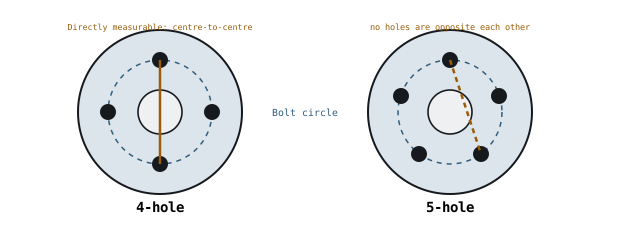
- Number of holes and bolt circle diameter — how many wheel bolts and what is the bolt circle diameter. For a four-hole pattern, measure from the centre of one hole to the centre of the hole directly opposite. With a five-hole pattern, this isn’t possible directly because no hole is directly opposite — in this case, it helps to check the vehicle documents or a photo of the back of the rim.
- Offset (ET) — see below.
- Hub bore (centre hole) — the diameter of the opening in the centre of the rim.
- Load capacity — the load index must match the axle load, and must be at least the value stated in the vehicle documents.
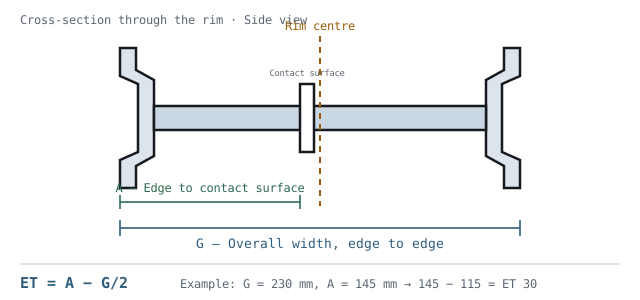
What the offset (ET) does: It indicates how far the contact surface of the rim is from the centre of the rim, and thus determines how far the wheel protrudes outwards or inwards. An ET that is too small will cause the wheel to rub against the outer edge of the mudguard; one that is too large will cause it to rub against the brake or the frame on the inside.
Reading the offset: It is usually stamped on the inside of the rim, for example ‘ET30’. If there is no stamp, measure it yourself.
Measuring the ET yourself — here’s how:
- Remove the wheel and lay it flat, ideally with the outer side facing downwards.
- Measure the total width G of the rim: from the outer edge of one rim flange to the outer edge of the other. Half of this distance is the centre of the rim.
- Measure dimension A: place a straight ruler across the top rim flange and determine the distance from this edge to the hub contact surface — that is, to the surface that rests against the vehicle.
- Calculation: ET = A − G/2
Example: Total width 230 mm, measurement A 145 mm. Centre of the rim = 115 mm. ET = 145 − 115 = 30. A positive result means that the contact surface lies outside the centre of the rim — this is the normal case. A value of zero means it is exactly centred, whilst negative values indicate it lies further inwards.
The quickest way is still to take a photo of the back of the old rim — this shows the bolt pattern and usually the embossed dimensions as well.
To choose from: complete wheels.
Note: Our complete trailer wheels are not balanced — this is not usually necessary for car trailers.
Reviews marked “Verified Purchase” are from customers who have bought the product from our shop. Reviews without this label may also be from consumers who have not purchased the products in question. These have not been verified for authenticity.
E-Mail adress: info@protempo-online.de
Streetaddress: Wülfrather Straße 35
ZIP Code: 42553
City: Velbert-Tönisheide
Country: DE
Phone: +49 (0)28217483000

