


16 inch PU tire 4.00-8 with plastic rim, 20 mm axle, puncture-proof
19,90 €
16 inch PU tire 4.00-8 with plastic rim, 20 mm axle, puncture-proof
19,90 €
Shipping price from: 6,90 €
Product Produit en stock

16 inch PU tire 4.00-8 with plastic rim, 20 mm axle, puncture-proof
Product.Nr.: 990017622

This PU tire (polyurethane) with a plastic rim is a robust, low-maintenance solution for wheelbarrows and hand carts in daily use. Polyurethane is a particularly durable material that, unlike air-filled tires, cannot burst-ideal when the tire must function reliably over the long term.
Thanks to the leak-proof, puncture-proof design, there is no need for reinflation and no risk of air loss. This makes the wheel especially suitable for intensive use in workshops, gardening and landscaping, agriculture, as well as on construction sites or in warehouse operations. The plastic rim is corrosion-free and suitable for everyday use, while the common size allows easy installation on many standard carts.
Technical data
- Tire type: PU tire (polyurethane), leak-proof/puncture-proof
- Rim: plastic rim
- Tire size: 4.00-8
- Diameter: 16 inches (approx. 400 mm)
- Axle diameter: 20 mm
- Suitable for: most standard wheelbarrows and hand carts
Note: Before purchasing, please check the tire size (4.00-8) and the axle diameter (20 mm) of your existing wheel to ensure proper fit.
Frequently asked questions about this product
To find a suitable complete wheel, we need five pieces of information:
- Tyre size — shown on the sidewall of the old tyre, for example 195/50 R13.
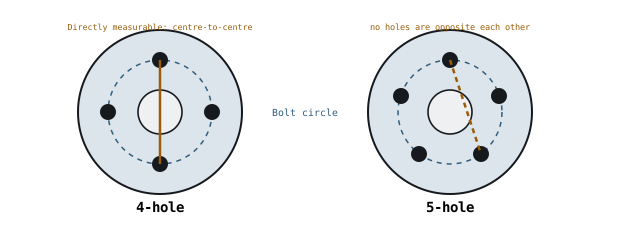
- Number of holes and bolt circle diameter — how many wheel bolts and what is the bolt circle diameter. For a four-hole pattern, measure from the centre of one hole to the centre of the hole directly opposite. With a five-hole pattern, this isn’t possible directly because no hole is directly opposite — in this case, it helps to check the vehicle documents or a photo of the back of the rim.
- Offset (ET) — see below.
- Hub bore (centre hole) — the diameter of the opening in the centre of the rim.
- Load capacity — the load index must match the axle load, and must be at least the value stated in the vehicle documents.
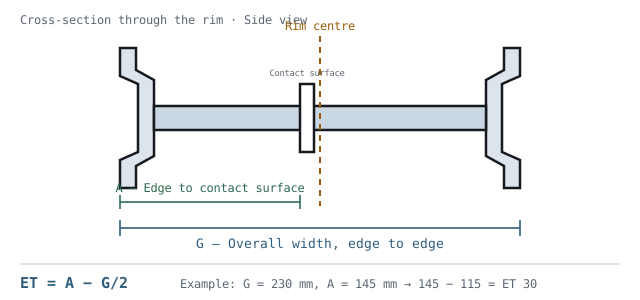
What the offset (ET) does: It indicates how far the contact surface of the rim is from the centre of the rim, and thus determines how far the wheel protrudes outwards or inwards. An ET that is too small will cause the wheel to rub against the outer edge of the mudguard; one that is too large will cause it to rub against the brake or the frame on the inside.
Reading the offset: It is usually stamped on the inside of the rim, for example ‘ET30’. If there is no stamp, measure it yourself.
Measuring the ET yourself — here’s how:
- Remove the wheel and lay it flat, ideally with the outer side facing downwards.
- Measure the total width G of the rim: from the outer edge of one rim flange to the outer edge of the other. Half of this distance is the centre of the rim.
- Measure dimension A: place a straight ruler across the top rim flange and determine the distance from this edge to the hub contact surface — that is, to the surface that rests against the vehicle.
- Calculation: ET = A − G/2
Example: Total width 230 mm, measurement A 145 mm. Centre of the rim = 115 mm. ET = 145 − 115 = 30. A positive result means that the contact surface lies outside the centre of the rim — this is the normal case. A value of zero means it is exactly centred, whilst negative values indicate it lies further inwards.
The quickest way is still to take a photo of the back of the old rim — this shows the bolt pattern and usually the embossed dimensions as well.
To choose from: complete wheels.
Note: Our complete trailer wheels are not balanced — this is not usually necessary for car trailers.
Last viewed

Reviews marked “Verified Purchase” are from customers who have bought the product from our shop. Reviews without this label may also be from consumers who have not purchased the products in question. These have not been verified for authenticity.
E-Mail adress: info@pateurope.com
Streetaddress: Haarspit 1
ZIP Code: 1724 BG
City: Oudkarspel
Country: NL
Phone: +31 (0)226331450

