Practical scenario: finding the right axle for an individual trailer build
A typical workshop situation looks like this: a small contractor wants to build a compact material trailer for tools and bags of mortar, a farmer needs a narrow special trailer for use between buildings, or a private trailer owner has an older unbraked trailer with a damaged axle and no exact replacement available anymore. In all three cases, the same problem appears quickly: the frame dimensions are fixed, but many standard axle assemblies are not.
That is where an adjustable universal running axle becomes genuinely useful. Instead of forcing your chassis design to match a rigid axle width, the axle itself can be adapted within a defined range. This is especially helpful when the contact dimension and mounting geometry must be set to suit an existing frame, a custom-built platform or a special-purpose body. For hobby mechanics, fabricators and repair workshops, that means fewer compromises and less time spent searching for rare spare parts with identical measurements.
In practice, this kind of component is often chosen for three jobs. First, for self-build trailers where the frame width is already determined by available steel sections, body panels or intended cargo. Second, for special trailers such as compact equipment carriers, garden trailers, mobile generator platforms or transport solutions for camping and leisure gear. Third, as a replacement axle when the original running gear is no longer available in the exact same dimensions.
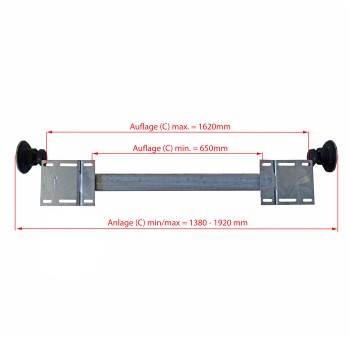
One detail that is often underestimated in the planning stage is how strongly axle geometry influences the entire trailer. If the mounting points do not line up properly, you may run into problems with wheel clearance, body alignment, mudguard positioning and load distribution. An adjustable system gives you more room to solve these issues correctly. Instead of accepting a near match, you can work within a contact dimension A from 650 to 1550 mm and a dimension C from 1380 to 1850 mm. That range covers many practical trailer projects that would otherwise require custom fabrication.
From workshop experience, this flexibility is particularly valuable when an older trailer frame has already seen repairs. It is common to find slight dimensional deviations between left and right mounting areas, previous welding work or non-original body conversions. With a fixed-width axle, such deviations often create unnecessary rework. With an adjustable design, you have a better chance of bringing the running gear into the correct position without rebuilding half the chassis.
For smaller unbraked car trailers up to 750 kg axle load, the right axle is not just a replacement part. It is one of the central structural elements that determines how the trailer sits on the road, how smoothly it runs and how reliably it handles daily use. Choosing an adaptable assembly can therefore make the difference between a workable compromise and a clean, technically sensible solution.
What makes the Flexi axle 750 kg 4 x 100 stand out
The Trailer axle - adjustable universal running axle - Flexi axle - 750 kg 4 x 100 is designed as an adjustable rubber spring axle for car trailers with an axle load of up to 750 kg. That puts it into the common range for many unbraked utility trailers, compact transport trailers and custom leisure builds. For many users, 750 kg is a practical class because it covers a broad spectrum of everyday transport tasks without moving into heavier chassis concepts.
The wheel connection is 4 x 100, a bolt pattern widely used for light trailer wheel and hub combinations. This matters in practice because wheel compatibility is one of the first checkpoints during any axle replacement or new build. If you already have rims in 4 x 100, or your planned wheel setup is based on that pattern, integration becomes much easier. It also simplifies sourcing matching wheels, wheel bolts and related accessories.
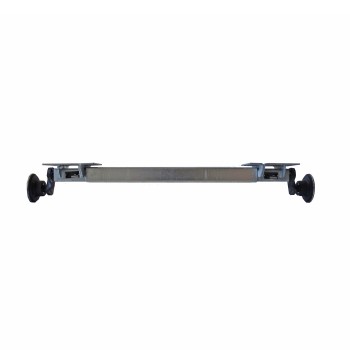
The core idea behind this universal running axle is straightforward and effective. The two axle ends are inserted into the centre tube to the required dimension and then locked in place. This modular arrangement allows the axle width to be adapted to the project instead of forcing the project to adapt to a fixed axle beam. For workshops and experienced DIY builders, that is a practical concept because it reduces the number of different axle variants needed for different frame widths.
Another advantage of this design is that it keeps the system comparatively simple. You are not dealing with a highly complex adjustable mechanism full of additional moving parts. Instead, the principle is based on two axle ends, one centre tube and defined fastening points. In trailer engineering, simple and clearly understandable assemblies are often preferable because they are easier to inspect, easier to align and easier to maintain over time.
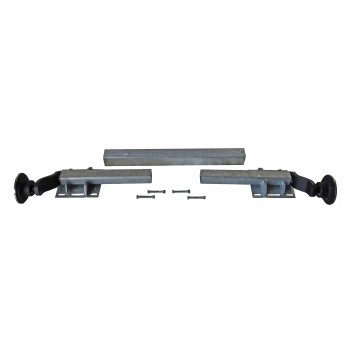
The supplied package includes the main components needed for installation: 2 axle ends, the centre tube, fastening material and wheel bolts. That means the essential parts are already coordinated as a set. For the installer, this reduces the risk of mixing incompatible hardware or losing time sourcing basic mounting items separately.
At a gross price of 210.00 EUR and a weight of 36.8 kg, this axle assembly sits in a practical category for builders looking for functional running gear rather than a highly specialized one-off solution. The article number 990014956 is useful to keep on hand when matching technical details, ordering related equipment or documenting the build for workshop records.
From a practical standpoint, one of the strongest points of this axle is not just that it is adjustable, but that it remains focused on common trailer requirements: 750 kg axle load, 4 x 100 wheel fitment and a broad dimensional adjustment range. Those are exactly the parameters that often decide whether a component becomes useful in real workshop conditions or remains too specific for most projects.
Flexible dimensions for many trailer projects
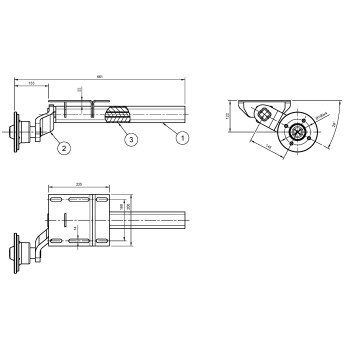
The key technical advantage of this Flexi axle lies in its dimensional flexibility. The contact dimension A can be set from a minimum of 650 mm to a maximum of 1550 mm. The dimension C can be adjusted from 1380 mm to 1850 mm. In practical terms, that gives you a wide working range for adapting the axle to different frame widths and mounting situations.
For self-builders, these numbers are more than catalogue data. They determine whether the axle can be integrated into the chassis without awkward spacer constructions, unnecessary bracket fabrication or changes to the body width. If you are building a trailer from scratch, this adjustment range allows you to finalize the frame design with more confidence. If you are replacing an old axle, it increases the chance that the new running gear can be matched to the existing structure.
The centre tube can also be shortened according to the manufacturer's specifications. This is a significant practical feature. In workshop reality, there are many trailer projects where the axle is close to fitting but not quite right in standard form. The ability to shorten the centre tube within the approved limits gives additional room to adapt the assembly properly. That can save considerable fabrication time compared with designing and welding a completely custom axle support arrangement.
However, this is also the point where careful measuring matters most. Before any installation work begins, you should measure the frame at several positions, not just at one point. Check the mounting faces, the inner and outer frame widths, the planned wheel centre position and the available clearance to mudguards, side panels and suspension travel space. On older trailers, it is wise to measure diagonally as well, because a frame that is slightly out of square can cause the axle to sit incorrectly even if the nominal width seems right.
A practical tip from trailer repair work: always define your wheel position first, then derive the axle setting from that. Many builders do it the other way around and later discover that the tyres sit too far inward or outward relative to the body. Start with the intended wheel and tyre combination, check the 4 x 100 hub fitment, calculate the required track position and only then set the axle dimensions. This sequence reduces the risk of clearance problems once the trailer is loaded.
Another useful point is to consider the full operating width, not just the unloaded static position. Tyres can flex under load, and body structures may have tighter clearances than expected. If your trailer is intended for rough yard use, farm tracks or ramps, allow a sensible safety margin around the wheel area. A technically correct axle installation is not only about making the dimensions fit on paper; it is about ensuring that the trailer remains functional when fully loaded and moving.
For special trailers, the broad adjustment range can solve unusual packaging problems. A narrow machine carrier, a compact camping gear trailer or a custom service trailer for tools may all require different mounting widths while still using the same basic running gear class. This is where universal components become valuable: they allow one adaptable solution to cover several applications that would otherwise need separate fixed-dimension parts.
Design and operating principle of the adjustable rubber spring axle
The construction principle of this adjustable axle is designed for practical adaptation. The two axle ends are inserted into the centre tube until the required dimension is reached. Once positioned correctly, they are locked in place to create a defined and stable assembly. This sounds simple, but in trailer engineering, a clean and robust principle is often exactly what makes a component reliable in service.
The axle uses a rubber spring design. In light trailer applications, rubber suspension systems are widely valued because they combine compact construction with dependable damping characteristics. Compared with more elaborate suspension arrangements, a rubber spring axle is relatively low-maintenance and well suited to utility trailers that must cope with changing loads, weather exposure and long periods of standing between uses.
In practical driving terms, the rubber spring effect contributes to smoother running and helps reduce harsh impacts transmitted from the road to the frame. That matters not only for comfort, but also for the trailer structure and cargo. Tools, garden equipment, camping items or sensitive loads benefit from reduced vibration compared with a very rigid setup. On a small trailer, even moderate damping improvements can make a noticeable difference to noise, body stress and wheel control.
Correct positioning of the axle ends inside the centre tube is critical. During installation, both sides must be aligned precisely so that the axle sits square to the direction of travel. Even a small deviation can result in poor tracking, uneven tyre wear or a trailer that appears to pull slightly to one side. In the workshop, this is why dry-fitting and repeated measurement are worth the extra time. Measure from fixed points on the frame to both hub positions and compare diagonal dimensions before final tightening.
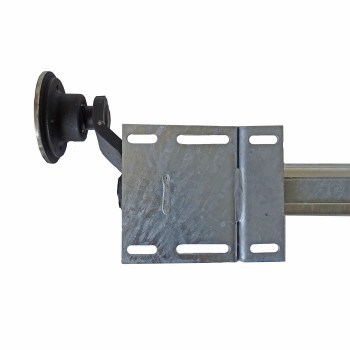
Another practical recommendation is to inspect the frame surfaces where the axle will be mounted. Dirt, old underseal, rust scale or weld spatter can prevent the assembly from seating evenly. Clean, flat contact surfaces help ensure that the fastening material can clamp the parts correctly and that the axle geometry remains consistent once loaded. If the frame shows deformation or corrosion damage around the mounting area, that should be repaired before the axle is installed.
Because the centre tube may be shortened according to the manufacturer's instructions, cutting accuracy also matters. A poor cut can lead to alignment issues during assembly. In practice, a square cut, careful deburring and accurate marking save time later. If you shorten the tube, check both the final dimension and the symmetry of the setup before locking everything in place. A few millimetres of error at the tube stage can become more noticeable at the wheel position.
Rubber spring axle systems are often appreciated because they offer a good balance between compactness and load-carrying ability. In the 750 kg class, this makes them especially suitable for everyday trailer duties where simplicity, durability and space-saving design are priorities. For many builders, that is exactly the combination needed: a compact running gear assembly that can be adapted to the chassis without introducing unnecessary complexity.
Ideal for self-builds, special trailers and as a replacement axle
This adjustable axle is particularly well suited to projects where standard fixed-dimension assemblies do not offer a clean fit. In self-build trailer construction, that situation is common. Builders often work with available steel profiles, existing body dimensions or specific transport requirements. As a result, the finished frame width may fall between common axle sizes. An adjustable unit closes that gap and makes the build more practical.
For special trailers, the benefit is even clearer. Not every trailer is a standard box trailer for general cargo. In daily workshop life, there are trailers for compact machinery, landscape equipment, mobile power units, event equipment, camping modules or custom storage bodies. These applications frequently demand non-standard mounting dimensions, while still using common wheel and load classes. A universal running axle with a 750 kg rating and 4 x 100 wheel connection can be a sensible basis for such concepts.
It is also a practical option as a replacement axle. Older trailers often present a familiar problem: the original axle dimensions are no longer available, the manufacturer has changed specifications or the trailer itself has been modified over the years. In such cases, searching for an exact spare part can take longer than the repair itself. An adjustable replacement assembly reduces that search effort and offers a realistic path to getting the trailer back into service.
For repair workshops, this kind of component can be useful stock because it covers a broad range of dimensional requirements. Instead of keeping multiple fixed-width axle variants on hand, one adaptable system may serve several common repair scenarios. That can simplify parts management and shorten turnaround time when a customer needs a practical solution rather than a historically exact reproduction.
There is another point worth mentioning from experience: universal parts are often most valuable when the trailer has already been altered. Added side panels, a new loading bed, repaired frame sections or modified mudguard positions can all change the effective installation situation. In these cases, fixed-dimension spare parts may technically belong to the original trailer model but no longer fit the actual trailer standing in the workshop. An adjustable axle is more forgiving of such real-world deviations.
For private users, the same logic applies on a smaller scale. If you are restoring a garden trailer, utility trailer or compact leisure trailer, you may not want to redesign the entire chassis around a hard-to-find original axle. An adaptable assembly gives you more freedom to complete the project properly. Combined with a common 4 x 100 wheel connection, it also helps when reusing or sourcing suitable wheels and related components.
In short, the strength of this axle lies in its versatility. It is not limited to one narrow trailer type. It works as a practical building block for new constructions, special-purpose equipment and replacement jobs where dimensional flexibility is the deciding factor.
Scope of delivery and what to watch during installation
The scope of delivery includes 2 axle ends, the centre tube, fastening material and wheel bolts. That gives you the essential assemblies required to build up the axle and prepare it for installation. For many projects, this is advantageous because the main components are already bundled and coordinated.
Before installation, there are three checks that should always come first. The first is dimensional compatibility. Confirm that your required contact dimension A falls within 650 to 1550 mm and that your required dimension C lies between 1380 and 1850 mm. The second is wheel compatibility. Make sure your wheel and hub setup is designed for the 4 x 100 bolt pattern. The third is load suitability. The axle is rated for up to 750 kg axle load, so the intended trailer design and operating use must remain within that limit.
In practice, it is also wise to check the entire running gear concept, not only the axle itself. Verify that the tyres, rims, wheel load rating and frame construction all match the planned use. A technically suitable axle cannot compensate for under-rated wheels or a weak chassis. If the trailer is intended for frequent commercial use, repeated full-load operation or rough ground, all surrounding components should be assessed with the same care as the axle.
When fitting the axle, follow the manufacturer's installation instructions exactly, especially if the centre tube is shortened. This is not an area for improvised modifications. The approved dimensions, cutting limits and fastening procedures exist to ensure the assembly works as intended. If the axle is installed outside those specifications, you risk misalignment, reduced durability or unsafe operating conditions.
One workshop tip that is not usually highlighted on product pages: tighten all mounting hardware only after the axle has been fully aligned and both wheel positions have been checked relative to the frame. If you lock one side too early, minor dimensional corrections become harder. Final tightening should come after verifying symmetry, squareness and clearance.
Another useful step is a controlled first test after installation. Rotate both wheel hubs, check for free movement, inspect clearances under simulated load and then carry out a short low-speed test run. After that, recheck all fasteners. On newly assembled trailer components, a follow-up inspection after the first kilometres is good workshop practice.
Because this axle assembly weighs 36.8 kg, safe handling during fitting matters as well. Use suitable lifting support or a second person when positioning the parts under the frame. This not only protects the installer but also helps prevent accidental misalignment or damage to the mounting surfaces during assembly.
If the trailer is being rebuilt as part of a larger restoration, take the opportunity to inspect adjacent components at the same time: wheel bearings, wheels, tyres, mudguard brackets, frame welds and lighting cable routing near the axle area. Combining these checks with the axle installation often saves time and prevents later rework.
Conclusion: a practical axle solution when dimensions need to work for the trailer, not against it
The Trailer axle - adjustable universal running axle - Flexi axle - 750 kg 4 x 100 is a sensible choice whenever a fixed-dimension axle would force unnecessary compromises. With an axle load of up to 750 kg, a common 4 x 100 wheel connection, adjustable contact dimension A from 650 to 1550 mm and dimension C from 1380 to 1850 mm, it covers a wide range of practical trailer applications.
Its design is especially useful for self-build trailers, special-purpose transport solutions and replacement jobs where original spare parts are difficult to source. The modular concept with two axle ends, centre tube, fastening hardware and wheel bolts keeps the assembly understandable and workshop-friendly, while the rubber spring principle supports smooth running and dependable everyday use.
If you plan carefully, measure accurately and follow the manufacturer's specifications for installation and any tube shortening, this axle can provide a clean and technically sound basis for many light trailer projects. For builders and repairers alike, that flexibility is often what turns a difficult chassis problem into a workable solution.
After the article, product images are automatically added as a gallery, so you can also take a closer look at the construction details and supplied components.






 C
C
 C
C
 B | 70db




Comments (0)
back to list Add comment